

Methyl ether, also known as dimethyl ether (DME), is a colorless gas with a faint, sweet odor. As a leading supplier of methyl ether in the market, we are deeply familiar with its physical properties, which play a crucial role in determining its wide - ranging applications. In this blog, we will delve into the various physical characteristics of methyl ether.
1. Basic Physical State and Appearance
Methyl ether exists as a gas under standard temperature and pressure (STP, defined as 0 °C and 1 atmosphere of pressure). It is colorless and has a relatively mild and sweet - like odor. This gaseous nature makes it easy to handle in systems designed for gaseous substances. For instance, in industrial settings where it is used as a fuel or as a propellant, its gaseous state allows for efficient transportation through pipelines and easy mixing with other gases.
2. Boiling and Melting Points
The boiling point of methyl ether is approximately - 24.8 °C. This low boiling point indicates that it readily vaporizes from the liquid to the gaseous state at temperatures well below room temperature. The melting point of methyl ether is around - 141.5 °C. These extreme values of boiling and melting points are due to the relatively weak intermolecular forces present in methyl ether. The main intermolecular force is the dipole - dipole interaction, but it lacks the strong hydrogen bonding that is found in some other compounds.
The low boiling point is a significant advantage in many applications. For example, in aerosol products, Dimethyl Ether Aerosol can quickly change from a liquid to a gas, creating the pressure needed to expel the product from the can. When the valve of an aerosol can is opened, the decrease in pressure causes the methyl ether to vaporize rapidly, pushing the product out in a fine mist.
3. Density
The density of methyl ether gas at STP is about 1.977 g/L. This density is slightly greater than that of air, which has a density of approximately 1.29 g/L at STP. The difference in density means that methyl ether will tend to sink in air under normal conditions. This property has safety implications. In case of a leak, the gas will accumulate in low - lying areas, which requires proper ventilation systems in storage and handling facilities to prevent the build - up of potentially explosive mixtures.

When methyl ether is in the liquid state, its density is approximately 0.668 g/cm³ at 20 °C. This density is lower than that of water (1 g/cm³), so liquid methyl ether will float on water.
4. Solubility
Methyl ether has limited solubility in water. It is sparingly soluble, with a solubility of about 328 g/L at 20 °C. This limited solubility is because methyl ether is a non - polar molecule overall, while water is a highly polar molecule. The "like - dissolves - like" principle dictates that non - polar substances are generally not very soluble in polar solvents.
However, methyl ether is soluble in many organic solvents such as ethanol, acetone, and diethyl ether. This solubility in organic solvents makes it useful in chemical reactions where it can act as a reactant or a solvent itself. For example, in some organic synthesis reactions, methyl ether can dissolve reactants and facilitate the reaction process.
5. Vapor Pressure
Methyl ether has a relatively high vapor pressure. At 20 °C, its vapor pressure is about 530 kPa. High vapor pressure means that the liquid form of methyl ether readily evaporates to form a gas. This property is exploited in its use as a refrigerant and a propellant. In refrigeration systems, the high vapor pressure allows for efficient heat transfer as the methyl ether changes between the liquid and gaseous states.
6. Flammability
Methyl ether is a highly flammable gas. It has a wide flammable range in air, with the lower explosive limit (LEL) of 3.4% by volume in air and the upper explosive limit (UEL) of 27% by volume in air. This wide flammable range means that even small leaks of methyl ether in an enclosed space can create a potentially explosive atmosphere.
When methyl ether burns, it produces carbon dioxide and water vapor according to the following chemical equation:
2(CH₃)₂O + 7O₂ → 4CO₂+ 6H₂O
This flammability property also makes it a suitable fuel. Dimethyl Ether Premium Grade can be used as a substitute for diesel fuel in some engines. It has a high cetane number, which means it ignites easily and burns efficiently, resulting in lower emissions compared to traditional diesel fuel.
7. Compressibility
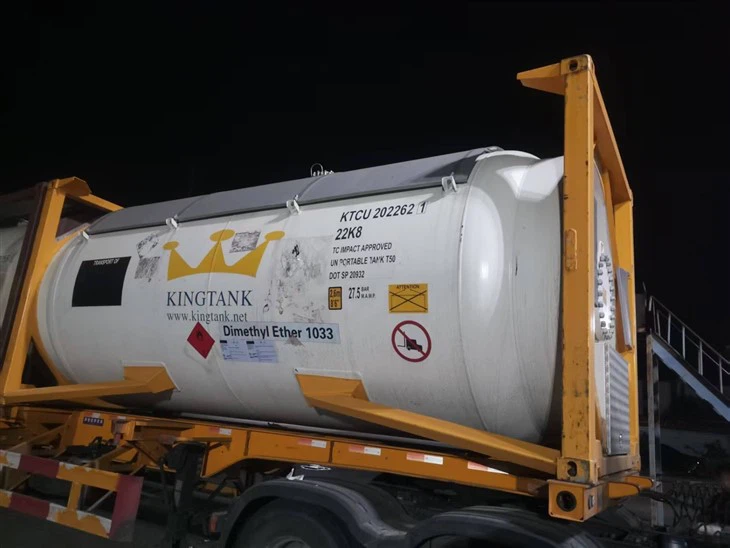
Methyl ether is highly compressible, which is a characteristic of gases. This compressibility allows it to be stored in high - pressure containers. For example, in the transportation and storage of methyl ether, it is often compressed into cylinders. The ability to compress the gas reduces the volume it occupies, making it more convenient and cost - effective to transport and store.
Applications Based on Physical Properties
The unique physical properties of methyl ether have led to its diverse applications. As mentioned earlier, its use as a propellant in aerosol products takes advantage of its low boiling point and high vapor pressure. In the energy sector, its flammability and high cetane number make it a promising alternative fuel. It can be blended with Isobutane Gas to improve combustion characteristics in some applications.
In the chemical industry, its solubility in organic solvents and reactivity make it a valuable intermediate in the synthesis of various chemicals. For example, it can be used in the production of dimethyl sulfate, which is an important industrial chemical.
Conclusion
In conclusion, the physical properties of methyl ether, including its boiling and melting points, density, solubility, vapor pressure, flammability, and compressibility, are what make it such a versatile substance. These properties determine its behavior in various applications, from aerosol products to alternative fuels and chemical synthesis.
As a reliable methyl ether supplier, we understand the importance of these physical properties and ensure that our products meet the highest quality standards. Whether you need Dimethyl Ether Premium Grade for fuel applications or Dimethyl Ether Aerosol for your aerosol products, we have the right solutions for you.
If you are interested in purchasing methyl ether or have any questions regarding its physical properties and applications, we encourage you to contact us. We are more than happy to engage in procurement discussions and provide you with the best possible service and product.
References
- Atkins, P. W., & de Paula, J. (2006). Physical Chemistry. Oxford University Press.
- Perry, R. H., & Green, D. W. (1997). Perry's Chemical Engineers' Handbook. McGraw - Hill.


