

As a supplier of difluoroethane, I'm often asked about how this important chemical is produced. Difluoroethane, also known as R152a, is a colorless gas with a faint ether - like odor. It has various applications, such as being used as a refrigerant and a propellant in aerosol products. In this blog, I'll delve into the production process of difluoroethane, sharing the scientific knowledge and industrial practices behind it.
Raw Materials
The production of difluoroethane starts with carefully selected raw materials. The primary raw materials used are vinyl chloride (C₂H₃Cl) and hydrogen fluoride (HF). Vinyl chloride is an important industrial chemical that can be produced through different methods, such as the direct chlorination of ethylene or the oxychlorination process. Hydrogen fluoride, on the other hand, is typically obtained from the reaction of fluorspar (CaF₂) with sulfuric acid (H₂SO₄).
Reaction Mechanism
The reaction between vinyl chloride and hydrogen fluoride to produce difluoroethane is a substitution reaction. The overall chemical equation for this reaction is:
C₂H₃Cl + 2HF → C₂H₄F₂+ HCl
This reaction is exothermic, which means it releases heat during the process. The reaction usually takes place in the presence of a catalyst. Commonly used catalysts include metal fluorides, such as antimony pentafluoride (SbF₅) or aluminum fluoride (AlF₃). These catalysts help to lower the activation energy of the reaction, increasing the reaction rate and improving the selectivity towards the formation of difluoroethane.
Industrial Production Process
Reaction Step
In an industrial setting, the reaction is carried out in a reactor. First, vinyl chloride and hydrogen fluoride are fed into the reactor in a carefully controlled ratio. The reaction temperature and pressure are also precisely regulated. The temperature is typically maintained in the range of 100 - 200 °C, and the pressure can vary from a few atmospheres to tens of atmospheres, depending on the specific reaction conditions and the type of catalyst used.
The catalyst is added to the reactor to initiate and accelerate the reaction. As the reaction progresses, the exothermic heat needs to be removed to maintain a stable reaction temperature. This is usually achieved through a cooling system, such as a jacketed reactor with a cooling medium flowing through the jacket.

Separation and Purification
After the reaction is complete, the reaction mixture contains difluoroethane, unreacted raw materials (vinyl chloride and hydrogen fluoride), and by - products (such as hydrochloric acid, HCl). The first step in the separation process is to remove the hydrochloric acid. This can be done by passing the reaction mixture through a scrubber, where the hydrochloric acid is absorbed by a suitable alkaline solution, such as sodium hydroxide (NaOH).
Next, the remaining mixture needs to be further separated to obtain pure difluoroethane. Distillation is the most commonly used separation method. The mixture is heated in a distillation column, and different components are separated based on their boiling points. Vinyl chloride has a boiling point of - 13.9 °C, hydrogen fluoride has a boiling point of 19.5 °C, and difluoroethane (R152a) has a boiling point of - 24.7 °C. By carefully controlling the temperature and pressure in the distillation column, difluoroethane can be separated from the unreacted raw materials.
Quality Control
Once the difluoroethane is separated and purified, it undergoes a series of quality control tests. These tests include analyzing the purity of the difluoroethane, checking for the presence of impurities, and measuring physical properties such as density, boiling point, and vapor pressure. Only when the product meets the required quality standards can it be packaged and sold.
Applications of Difluoroethane
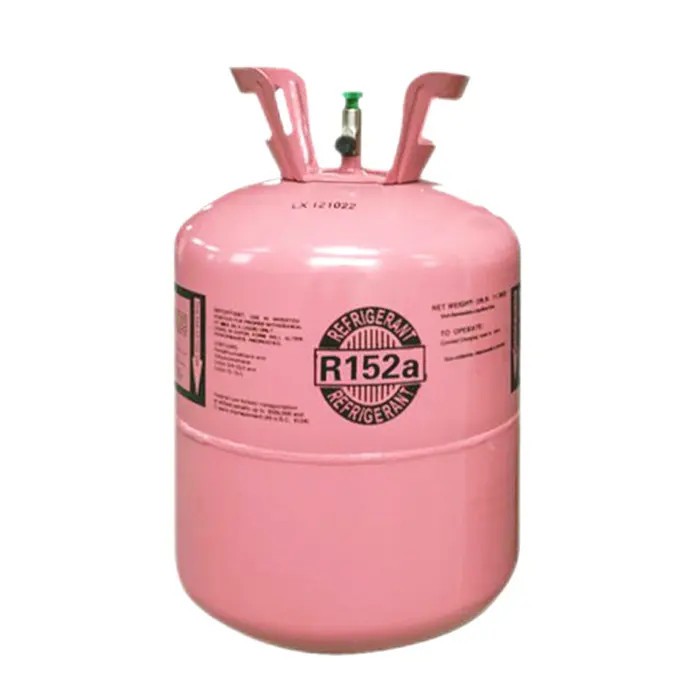
Difluoroethane has a wide range of applications. One of the most important applications is as a refrigerant. R152a Refrigerant is known for its relatively low global warming potential (GWP) compared to some other traditional refrigerants. It is used in various refrigeration systems, including domestic refrigerators, air - conditioning units, and automotive air - conditioning systems.
In addition to its use as a refrigerant, difluoroethane is also used as a propellant in aerosol products. R152a Gas provides the necessary pressure to expel the contents of the aerosol can. It is used in products such as hair sprays, deodorants, and paint sprays.
Our Role as a Supplier
As a difluoroethane supplier, we are committed to providing high - quality products to our customers. We have established a strict quality control system throughout the production process to ensure that our difluoroethane meets the international quality standards. Our production facilities are equipped with advanced technology and equipment, which allows us to produce difluoroethane efficiently and with high purity.
We also offer customized solutions to meet the specific needs of our customers. Whether you need difluoroethane for refrigeration applications or as a propellant in aerosol products, we can provide the right product with the appropriate specifications.
Contact Us for Procurement
If you are interested in purchasing difluoroethane for your business, we would be delighted to have a discussion with you. Our team of experts can provide you with detailed product information, technical support, and competitive pricing. We believe that our high - quality difluoroethane and excellent customer service will meet your expectations. Please feel free to reach out to us to start a procurement discussion.
References
- "Industrial Organic Chemistry" by Klaus Weissermel and Hans - Jürgen Arpe.
- "Chemical Process Technology" by Stanley M. Walas.
- Journal articles on the synthesis and applications of difluoroethane from scientific databases such as ScienceDirect and ACS Publications.
